
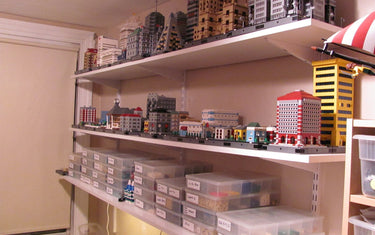
A LEGO® collection can outgrow its original shelf surprisingly quickly. A few cars become a full racing lineup, a favorite building takes over the desk, and minifigures start filling every available gap.
You do not need a dedicated collection room to enjoy your finished builds. The most useful LEGO display ideas for small spaces begin with choosing what to show, measuring the space you already have, and giving each model a clear place.
Wall displays, compact cases, existing bookshelves, and rotating collections can all help. The right combination depends on the size of your builds and how often you want to take them down.
This guide explores nine practical ways to display LEGO sets in a small bedroom, home office, apartment, or shared living space.
Before You Start: Measure the Model and the Space
Before buying another shelf or rearranging the room, measure your largest models and the places where they could go.
Record three dimensions for each build:
-
Width: Include wings, mirrors, wheel arches, and other projecting parts.
-
Depth: Measure the model in the position you intend to display it.
-
Height: Include antennas, stands, raised accessories, and minifigures.
Then measure the available shelf, desk, or wall area. Leave enough room to lift the model out, remove a cover, or reach behind the display.
For wall-mounted arrangements, consider how far the complete display will project into the room. A frame may free up a desk while still needing clearance beside a doorway or chair.
Keep the set number with your measurements. If you need to identify a model or check its original assembly, the official LEGO building instructions library lets you search for instructions by set.
Move Suitable Car Models onto the Wall

Car collections can occupy a long stretch of shelf space when displayed in a single row. Moving compatible models onto a wall can leave that surface available for buildings, larger sets, or everyday use.
LEGO display frames are one option for creating a defined arrangement around a car or group of cars. They work particularly well when you want the collection to become a visible part of the room.
Start by choosing a section of wall that you can see comfortably from your usual seat. Plan the full outline with paper templates before installation, including the space between frames.
When comparing wall display frames for LEGO models, check the supported set numbers, overall dimensions, and mounting requirements. A frame designed for one vehicle should not be assumed to fit another.
Follow the mounting system’s instructions and use fixings suitable for the wall and total installed weight. An open frame also leaves the model exposed to dust unless a compatible cover is included.
Rearrange the Bookshelves You Already Own

An existing bookshelf may have more usable display space than it first appears.
Start by removing items you no longer need to keep on show. Then group the remaining books, storage boxes, and models into separate sections rather than spreading everything across every shelf.
If the shelf heights are adjustable, match them to the builds. A small car collection rarely needs the same vertical clearance as a tower or spacecraft.
Try these arrangements:
-
Place similarly sized models together.
-
Keep the front edge clear enough to see each build.
-
Use a simple background behind visually detailed models.
-
Leave access to drawers, doors, and adjustable shelf fittings.
Check the furniture’s load limits, and follow its manufacturer’s instructions for securing it where required. Avoid balancing models on edges or placing them where opening a door could knock them over.
Give Your Desk One Main Display
A small desk has to accommodate more than collectibles. Monitors, keyboards, lamps, notebooks, and charging cables all need working space.
Instead of arranging several unrelated builds around these items, choose one model as the main display. A favorite car, small architectural build, or character model can give the desk personality without crowding the work area.
Position it where it remains visible without blocking the screen, speakers, ventilation, or daily movement.
A useful test is to sit down and complete your normal tasks. If you need to move the model every time you work, the arrangement needs adjusting.
Keep other builds on a nearby shelf or rotate them into the same position. This gives each model time in view while preserving a usable desk.
Use Different Levels for Minifigures
Minifigures take up little space individually, but a growing collection becomes difficult to see when every figure stands at the same height.

A tiered arrangement raises the back rows so they are less likely to disappear behind the front ones. You can organize the figures by theme, series, character group, or color.
Before choosing a display, check more than the advertised capacity. Tall headgear, wings, weapons, and large accessories can change the amount of space each figure needs.
For example, a tiered minifigure display case provides a way to group characters within a defined area. Compare the shelf clearance and usable space with your own figures rather than assuming every arrangement will fit the maximum stated number.
Try a temporary layout first. Leave room to remove a figure without disturbing the entire row.
Group Small Cars into One Planned Arrangement
Several individual car displays can leave awkward gaps between them. A shared layout helps you plan the collection as a whole.
For Speed Champions cars, consider grouping by:
-
Manufacturer or racing team.
-
Road cars and race cars.
-
Color palette.
-
Release period.
-
A personal theme, such as favorite drivers or memorable builds.

Keep the viewing angle consistent where practical. Cars arranged with similar spacing and orientation are easier to compare.
A multi-car Speed Champions F1 display frame is one example of a shared wall arrangement. Before choosing a multi-car product, verify the compatible models and the complete frame size; a layout designed around particular F1 cars may not suit every Speed Champions vehicle.
If the available wall is narrow, compare smaller groups or a vertical arrangement rather than choosing capacity alone.
Match Display Cases to Your Shelf Depth
A case that fits the model may still be too large for the furniture beneath it.
When considering LEGO display cases, compare both sets of dimensions:
| Measurement | What it helps you check |
| Internal width, depth, and height | Whether the model fits inside |
| External dimensions | Whether the case fits the furniture |
| Base dimensions | Whether the base is fully supported |
| Opening or cover clearance | Whether you can access the model |
| Model plus stand dimensions | Whether accessories fit too |
A compact case can help define the space around one build, but putting a large box around a small model may consume space you could use elsewhere.
Browse display cases for LEGO collections with your measurements beside you. If internal dimensions are unclear, confirm them before ordering.
For a shelf with several cases, also check the combined weight against the furniture’s stated limits.
Rotate Your Collection Instead of Showing Everything
Displaying every finished set at once is not the only way to enjoy a collection.
Choose a small selection for the main display and keep the rest in suitable storage. Change the selection when you finish a new build, want a different theme, or feel ready to revisit an older favorite.
You could rotate:
-
A racing lineup.
-
Seasonal builds.
-
A favorite film or franchise.
-
Models with a shared color palette.
-
One large centerpiece and a few smaller supporting builds.
Photograph each arrangement before changing it. This makes it easier to recreate layouts you enjoyed.
Keep stored models or loose pieces organized by set, and label any parts removed for storage. LEGO’s official sorting and storage guidance recommends a dry location away from heat sources and direct sunlight.
Organize Small Displays into Clear Zones
A room can feel crowded when individual models are scattered across every available surface.
Instead, create a few display zones with a clear purpose. One shelf might hold cars, another might hold a city scene, and a small desktop area might feature the latest build.

Within each zone, use repetition to connect the models. Similar bases, consistent spacing, or a shared background color can help different builds feel related.
Leave some visible space around each group. You do not need to fill every gap with another accessory.
This approach is especially useful in shared rooms. A defined collection area is easier to maintain than a display that gradually spreads across worktops, windowsills, and furniture.
Start with what you already own and rearrange it before adding more display equipment.
Plan for the Next Build
A layout that uses every available centimeter leaves little flexibility when the collection grows.
Before filling the final gap, consider what you are likely to build next. Will it be another car of a similar size, a tall building, or a much larger centerpiece?
You do not need to predict every purchase. Instead, choose an arrangement that can adapt:
-
Leave an adjacent section of wall available.
-
Keep one shelf adjustable.
-
Use repeatable groups rather than one tightly packed composition.
-
Reserve a rotating position for new builds.
-
Check whether future additions can use the same display system.
When planning several frames, calculate the full arrangement rather than multiplying model dimensions alone:
Total width = combined frame widths + gaps between frames.
For example, three hypothetical frames that are each 30 cm wide, with two 5 cm gaps, would need 100 cm of wall width—about 39.4 inches. That calculation does not include any additional clearance required by the mounting instructions.
Which LEGO Display Idea Fits Your Space?
Use this table to narrow down your options before changing the room.
| Your situation | A useful starting point | Check first |
| No spare desk space | Compatible wall display | Wall type, mounting instructions, projection |
| Existing bookshelf | Rearranged shelf layout | Shelf depth, load limits, access |
| Many small cars | Grouped collection display | Model compatibility and spacing |
| Growing minifigure collection | Tiered arrangement | Accessory height and row visibility |
| One favorite model | Dedicated desk or shelf position | Everyday working space |
| Frequent collection changes | Rotating display | Organized storage and easy access |
| Dust is a concern | Enclosed display | Panel fit and cleaning access |
You can combine these approaches. A wall arrangement for cars, a case for a favorite build, and a rotating shelf can serve different parts of the same collection.
Frequently Asked Questions
How do you display LEGO sets in a small room without drilling?
Start with an existing bookshelf, a stable desktop position, or a freestanding display case that fits your furniture. Rotating the models on display also reduces the amount of permanent space you need.
Do not assume adhesive hooks can support a frame and model unless the complete mounting system is specifically rated for that use.
What is a good way to display LEGO cars in a small space?
For a few cars, a shelf or compact case may be enough. For a larger collection, compare grouped shelf layouts with compatible wall displays.
Measure the complete arrangement and check each model’s fit. The option that holds the most cars is not always the easiest to view or access.
Do LEGO display frames protect models from dust?
An open display frame leaves the model exposed. Some frames offer an optional cover, while enclosed cases provide panels around the model.
Check what is included in the version you choose. A decorative background or frame alone does not provide full dust protection.
How much space should you leave around a LEGO model?
There is no single clearance that works for every model. Allow for projecting parts, the display stand, and the movement needed to install or remove the build.
A case with a lifting cover needs different access space from a frame with a removable front panel.
Can you put different LEGO themes in the same display?
Yes. A shared scale, color palette, background, or layout can connect different themes.
If the models vary greatly in size, use one as the main focal point and place smaller builds where they remain visible.
Should you display LEGO sets near a window?
Choose a position outside direct sunlight and away from heat sources. A clear cover should not be assumed to provide UV protection unless the manufacturer specifically documents that feature.
Check the light reaching the display at different times of day before choosing a permanent location